Shubunkin Goldfish: The Ultimate Care Guide (+ Size, Breeding, Lifespan)

Updated on

Want to learn about the amazing Shubunkin goldfish? You’ve come to the right place! Today we’re going to dive into learning about this popular breed of goldfish.
I also have some little-known fascinating facts to share…
So let’s get to it!

Quick Facts about Shubunkin Goldfish
| Species Name: | Carassius auratus auratus |
| Temperature: | 65°–70° F |
| Temperament: | Athletic, Playful |
| Lifespan: | 10–15 years |
| Size: | 12”–14” |
| Hardiness | Very Hardy |

Shubunkin Goldfish Breed Overview
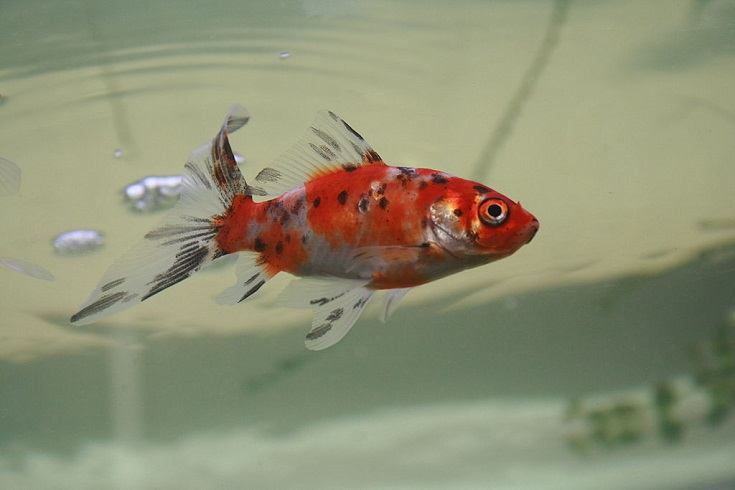
No matter the fin type or coloration, Shubunkins are among the hardiest of all types of goldfish. Their longer bodies mean swim bladder trouble is almost non-existent. They make excellent pond fish and are known to tolerate even very cold winters outdoors. There are three main types of Shubunkins (the difference is in the tail):
- The Bristol Shubunkin, which has a much taller, fuller tail shaped like the letter “B”
- The American Shubunkin, which has the same tail shape as a regular Comet goldfish.
- The London Shubunkin, which has a shorter tail like a Common goldfish (in fact, it was probably a cross between a Common and a Japanese Shubunkin.)
Bristols are much harder to find in the US than Americans. They originated in Bristol, UK. When they come up for sale, they can be quite pricey.
Coloration
Did you know these fish actually come in a variety of color patterns? Their colors are a huge part of making these fish so interesting. Guess what? No two fish are identical in terms of their markings. Interestingly enough, color changes are pretty common on Shubbies as they age. So be prepared in case your fish changes color later on—especially if you start with a younger fish.
- The typical Calico Shubunkin you’ll find at the pet store looks like a calico-colored Comet goldfish, with patches of red, black, and white. They usually have some shiny scales amidst mostly non-shiny ones.
- Midnight Shubunkins are predominantly black with a bit of white. Black Opal Shubunkin goldfish are very similar in terms of markings, which have very pronounced blacks.
- Ghost Bristol Shubunkins (also known as “pinkies”) are entirely white matt with no metallic scales and pink gills. Most have button eyes. Their tail is the heart-shaped kind that Bristols have.
- Imperial Shubunkins have solid red coloration. Some of them even have special shiny scales.
- Sanke Gold Shubunkins have a very bright white (not blue) base with strong pops of red and black. This is a very hard-to-find and costly color pattern.
- Sky Blue Shubunkins have no red and very little black markings with a matt base and a sprinkling of metallic scales. Sometimes they have pink gills. Their unique coloring makes them look almost iridescent. This color pattern can be very difficult to find and expensive.
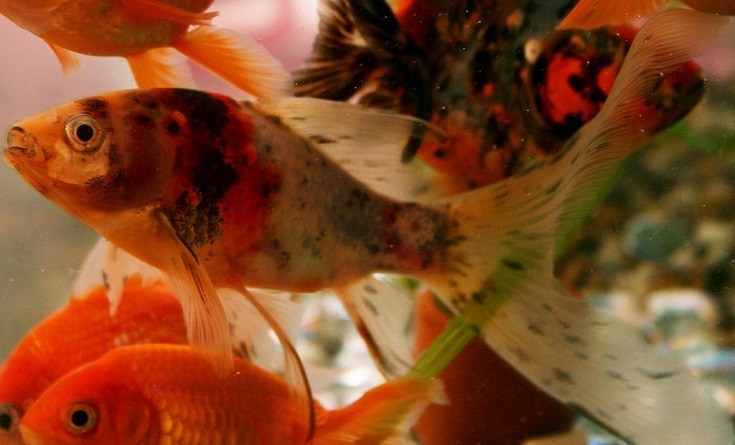
In the opinion of many goldfish breeders: The bluer that is on the fish, the better. The blue you see on the fish is actually black showing through from the skin of the fish. This is similar to what makes blue mystery snails appear the color they do. Black sometimes gives way to red coloration as the fish ages or is exposed to different environmental conditions.
Here’s an example of a Black Opal Shubunkin with blue undertones:
If the fish is red and white with some shiny scales and lacks any black pigment, it is no longer a Shubunkin—it is a Sakura Comet. A black and orange or black and yellow fish without any white markings is known as “tiger.” (These are very rare.)
Thoughts on Long Fins
The tails on both the Bristol and especially the American varieties continue to lengthen with age in proportion to the body size (sometimes even equaling the length of the body)! How long the fish’s fins get also depends on genetics. Very long fins might LOOK beautiful…
But they can pose some potential problems.
As the fish continues to grow larger, the fins do too—and sometimes they can become so huge that they weigh the fish down, causing them to sit on the bottom.
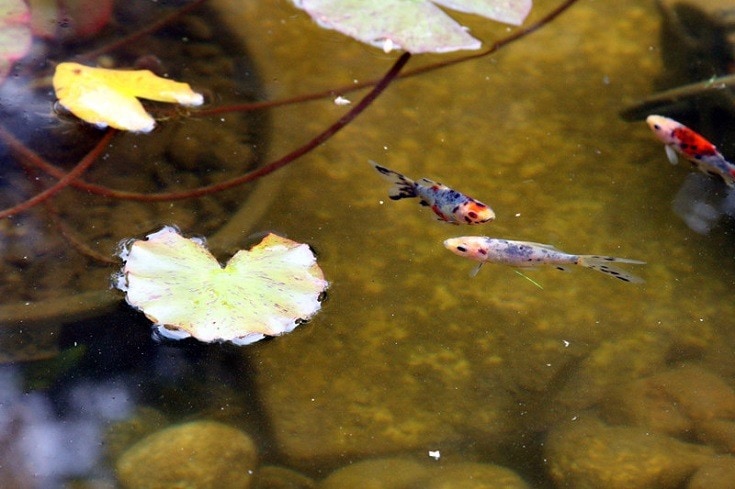
The long fins can also drag along objects at the bottom, leading to abrasions and scar tissue buildup that looks like whitish lumps. Such long-finned fish also are prone to issues like fin rot and fin congestion. You’ll often notice redness or ragged edges with older fish.
It’s probably safe to say that the London Shubunkin is the least likely of the three varieties to have tail problems (of course, it might not look as nice to some people!).
The good news? These problems might not happen if the fish doesn’t grow much.
Size
Shubunkin goldfish can get absolutely HUGE when they are given lots of fresh water. They can even get up to 14″ long (including the tail)!
Crazy, right? Their large size potential also makes them a popular choice for goldfish ponds. That said, like other goldfish, they have the ability to regulate their size in a smaller environment by producing the growth-inhibiting hormone somatostatin. If access to fresh water is limited, they might not get much larger than 3–5 inches.
If you're new to the world of goldfish or are an experienced goldfish keeper that loves to learn more, we recommend you check out our best-selling book, The Truth About Goldfish, on Amazon. From diagnosing illnesses and providing correct treatments to ensuring your goldies are happy with their setup and your maintenance, this book brings our blog to life in color and will help you to be the best goldfishkeeper you can be. 
How to Take Care of Your Fish Properly
Lifespan
The typical lifespan of a Shubunkin is 10–15 years… a good bit more than a fancy goldfish.
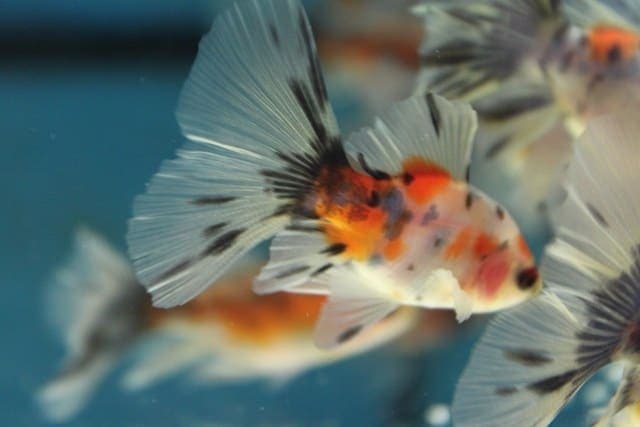
Their greater resistance to disease and more natural long-bodied structure enables them to keep on swimming longer than you might think. When allowed to go through seasonal winter hibernation, this can greatly add to their lifespan.
Housing
Shubunkins need to be provided with clean water to stay healthy. To that end, it’s a good idea to make sure your fish’s home has some kind of filter to keep the ammonia and nitrites down between water changes.
This also applies if you keep your fish in a pond (though your filter will likely need to be much larger!). Shubunkins are athletic fish and should also be provided with sufficient swimming space to prevent muscle atrophy.
Water Temperature
These fish aren’t very demanding in terms of water temperature and can be quite flexible. As hardy fish, Shubbies can tolerate water that is on the colder side—65–70 degrees F is ideal for the warmer months.
In the wintertime, they can even survive temps well below 50 degrees F as they go into hibernation. They breed readily when things warm up in the spring, laying thousands of eggs!
Are Shubunkin Goldfish Good Tank Mates?
Shubunkin goldfish do fantastic with other athletic breeds of goldfish, especially Commons and Comets. Some people even keep theirs outside with their Koi!
What to Feed Your Shubunkin Goldfish
Shubunkins aren’t super picky fish and do well on a diet of Omega One pellets and plant matter foraging (lettuce is a good one). Goldfish kept in a pond have access to natural foraging material like insects, rotting plants, and algae. The occasional earthworm is greatly appreciated as well.
Read more about feeding here.
Final Thoughts
Shubunkins make an excellent, hardy pet fish. Do you own one (or have you ever owned one)? If so, I’d love to hear about yours! Or maybe you learned something new. Either way, do leave your comment below—I love hearing from you!
- Related Read: Imperial Goldfish
Featured Image: slowmotiongli, Shutterstock